French investigators have disclosed that the nose-wheel of an Air Antilles De Havilland DHC-6 was not centred before the turboprop veered off the runway while landing and collided with a parked helicopter.
While none of the DHC-6’s eight occupants suffered serious injury in the accident at Saint-Barthelemy airport, the aircraft’s left wing was torn off and the helicopter – an Airbus Helicopters H125 – suffered sufficient damage to be considered economically unrepairable.
French investigation authority BEA found that operator CAIRE, which included Air Antilles, had not incorporated into DHC-6 manuals a 2017 checklist amendment intended to ensure the nose-wheel was both centred and locked after take-off and before landing.
This centring is achieved by aligning marks on the nose-wheel steering lever, located on the control column. But the amendment directs pilots to check the nose-wheel is locked in this position by applying a slight upward and downward pressure to the lever.
“The [nose-wheel steering] check after take-off and before landing was therefore not carried out, with the crew not making a manual input on the [steering] lever,” says BEA, in its findings into the 24 August 2023 accident.
Examination of the nose-wheel steering control cable revealed that the tension was insufficient, although the reason for the incorrect adjustment could not be determined.
As a result, the nose-wheel was probably not centred even though the steering lever marks were aligned, and neither was the nose-wheel locked.
“The nose-wheel probably pivoted during the flight,” says the inquiry.
BEA notes that cockpit-voice recorder information showed that the pilots did not observe the ‘sterile cockpit’ rule – nearly 60% of the time 8min 46s spent below 5,000ft during the approach was “devoted to conversation unrelated to the flight”.
“Moments of silence were nearly non-existent,” it says, and points out that the crew forgot to inhibit terrain alerts as the aircraft descended towards Saint-Barthelemy’s runway 28.
When the aircraft touched down it veered to the left. The captain, who was flying, took several actions in a bid to correct the course, including braking, steering and applying reverse thrust.
But he could not stop the DHC-6 from veering off the left side of the runway, crossing a grass shoulder and hitting a taxiway sign before striking the helicopter with its left wing. The aircraft (F-OMYS) pivoted before coming to a halt, and was subsequently evacuated.

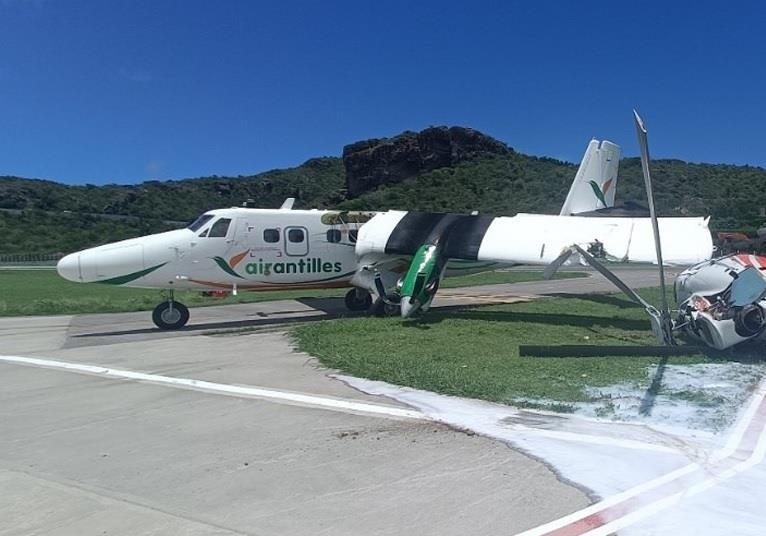


French investigators have disclosed that the nose-wheel of an Air Antilles De Havilland DHC-6 was not centred before the turboprop veered off the runway while landing and collided with a parked helicopter.
While none of the DHC-6’s eight occupants suffered serious injury in the accident at Saint-Barthelemy airport, the aircraft’s left wing was torn off and the helicopter – an Airbus Helicopters H125 – suffered sufficient damage to be considered economically unrepairable.
French investigation authority BEA found that operator CAIRE, which included Air Antilles, had not incorporated into DHC-6 manuals a 2017 checklist amendment intended to ensure the nose-wheel was both centred and locked after take-off and before landing.
This centring is achieved by aligning marks on the nose-wheel steering lever, located on the control column. But the amendment directs pilots to check the nose-wheel is locked in this position by applying a slight upward and downward pressure to the lever.
“The [nose-wheel steering] check after take-off and before landing was therefore not carried out, with the crew not making a manual input on the [steering] lever,” says BEA, in its findings into the 24 August 2023 accident.
Examination of the nose-wheel steering control cable revealed that the tension was insufficient, although the reason for the incorrect adjustment could not be determined.
As a result, the nose-wheel was probably not centred even though the steering lever marks were aligned, and neither was the nose-wheel locked.
“The nose-wheel probably pivoted during the flight,” says the inquiry.
BEA notes that cockpit-voice recorder information showed that the pilots did not observe the ‘sterile cockpit’ rule – nearly 60% of the time 8min 46s spent below 5,000ft during the approach was “devoted to conversation unrelated to the flight”.
“Moments of silence were nearly non-existent,” it says, and points out that the crew forgot to inhibit terrain alerts as the aircraft descended towards Saint-Barthelemy’s runway 28.
When the aircraft touched down it veered to the left. The captain, who was flying, took several actions in a bid to correct the course, including braking, steering and applying reverse thrust.
But he could not stop the DHC-6 from veering off the left side of the runway, crossing a grass shoulder and hitting a taxiway sign before striking the helicopter with its left wing. The aircraft (F-OMYS) pivoted before coming to a halt, and was subsequently evacuated.
Source link
Share This:
skylinesmecher
Plan the perfect NYC Memorial Day weekend
Pack only what you need and avoid overpacking to streamline the check-in and security screening…
LA’s worst traffic areas and how to avoid them
Consider using alternative routes, such as Sepulveda Boulevard, which runs parallel to the 405 in…
Nose-wheel misalignment preceded DHC-6’s excursion and collision with helicopter
French investigators have disclosed that the nose-wheel of an Air Antilles De Havilland DHC-6 was…
Swedish military advances Esrange satellite launch site plans with SSC Space
NATO member Sweden has signed an agreement paving the way for it to commence satellite…
BA to return to Melbourne, Colombo after decades-long hiatus | News
British Airways will resume operations to Melbourne and Colombo during the Northern Winter schedule –…
Airbus Defence & Space prepares Valkyrie pair for ‘UCCA’ mission test alongside Eurofighter for Germany
Targeting the delivery of a ‘loyal wingman’-type capability for the German air force before the…
Baykar Technology aces AI-enabled drone swarm trials with five new ‘K2 Kamikaze’ aircraft
Turkish uncrewed aerial vehicle (UAV) developer Baykar Technology has unveiled what it describes as the…
Leonardo to demonstrate M-346 commanding two Baykar uncrewed fighters by mid-year
Leonardo will conduct the first demonstration flight later this year pairing its M-346 platform with…
B-1B bombers load bombs and cruise missiles at RAF Fairford for Iran air strikes
Amid the ongoing US-Israeli air campaign against Iran, US Air Force (USAF) bombers have been…
Russia expands Yelabuga UAV factory to 116 buildings for Ukraine war
Russia has vastly expanded its unmanned air vehicle (UAV) production facilities in the Yelabuga special…
Azur Air operations restricted as Russian regulator demands resolution of flight shambles
Russian air transport regulator Rosaviatsia has imposed restrictions on the operations of leisure carrier Azur…
Transformed Leonardo is primed for major growth, CEO Cingolani says
Looks can be deceiving. Take as an example Leonardo’s choice of venue for the launch…