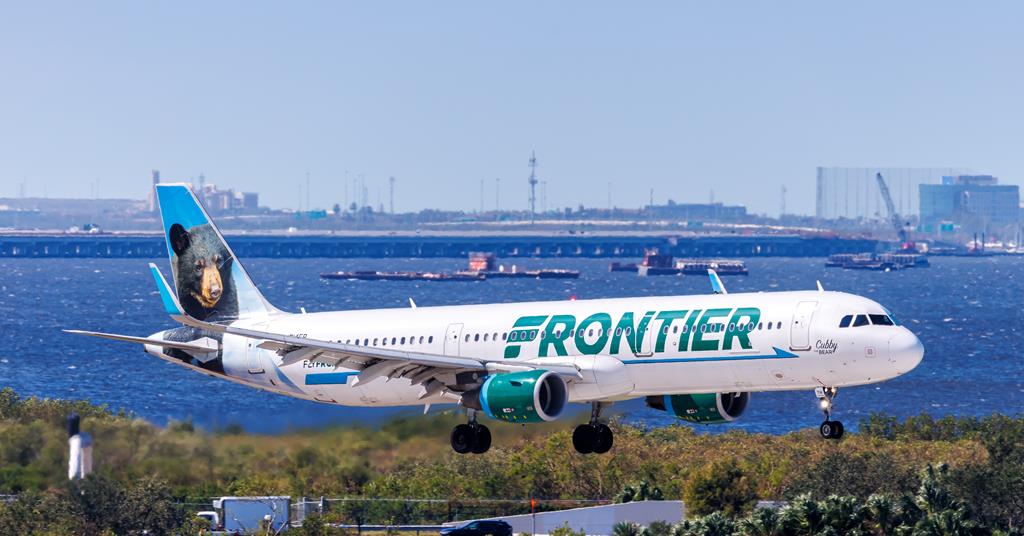
German airline representatives are claiming that point-to-point carriers have not restored their fleets stationed in the country to pre-pandemic levels, and that recovery has stagnated over government-imposed costs.
The German aviation association BDL states that the number of aircraft stationed in Germany by European point-to-point operators is down by 30% – from 190 to 130 – in the six years since 2019, just prior to the onset of the Covid-19 pandemic.
BDL says carriers are “avoiding” Germany and the fleet relocation amounts not only to lost connectivity but also a depletion of the economy.
“Every aircraft stationed in Germany is equivalent to a medium-sized company,” it says, claiming that equates to some 170 jobs and €70 million in gross domestic product contribution.
BDL adds that the situation is also reflected in German airport performance.
Frankfurt airport recorded passenger figures of 61.6 million last year, down 12.7% on 2019, while Munich’s total of 41.6 million was 13.1% lower.
The operator of Frankfurt airport, Fraport, has similarly attributed the weakened recovery to “high state-regulated site costs…namely, air traffic tax”.
BDL says the first six months of this year have not indicated any improvement. It states that the recovery “virtually came to a standstill” over the first half, as a result of the “excessive” costs – while air traffic in other European countries is, on average, “significantly” above pre-pandemic levels.
“We are seeing the consequences at almost every airport in Germany,” says BDL president Jens Bischof. “Airlines are withdrawing their aircraft and deploying them in other European countries with competitive cost levels.
“In view of this alarming development, it is essential that the federal government prioritises the crisis facing Germany as a location for air transport.”
Bischof insists the tax of around €35 ($41) per passenger “must” be halved to alleviate the burden.
“By deciding against urgently-needed relief…the German federal government would be squandering an important opportunity for new economic growth,” he adds.
Analysis from BDL indicates that the annual number of flights between Germany and other European countries, around 1.1 million, is 20% below pre-pandemic levels, while domestic traffic was also “significantly weaker” – just under half of 2019 figures, including feeder flights to Frankfurt and Munich.


German airline representatives are claiming that point-to-point carriers have not restored their fleets stationed in the country to pre-pandemic levels, and that recovery has stagnated over government-imposed costs.
The German aviation association BDL states that the number of aircraft stationed in Germany by European point-to-point operators is down by 30% – from 190 to 130 – in the six years since 2019, just prior to the onset of the Covid-19 pandemic.
BDL says carriers are “avoiding” Germany and the fleet relocation amounts not only to lost connectivity but also a depletion of the economy.
“Every aircraft stationed in Germany is equivalent to a medium-sized company,” it says, claiming that equates to some 170 jobs and €70 million in gross domestic product contribution.
BDL adds that the situation is also reflected in German airport performance.
Frankfurt airport recorded passenger figures of 61.6 million last year, down 12.7% on 2019, while Munich’s total of 41.6 million was 13.1% lower.
The operator of Frankfurt airport, Fraport, has similarly attributed the weakened recovery to “high state-regulated site costs…namely, air traffic tax”.
BDL says the first six months of this year have not indicated any improvement. It states that the recovery “virtually came to a standstill” over the first half, as a result of the “excessive” costs – while air traffic in other European countries is, on average, “significantly” above pre-pandemic levels.
“We are seeing the consequences at almost every airport in Germany,” says BDL president Jens Bischof. “Airlines are withdrawing their aircraft and deploying them in other European countries with competitive cost levels.
“In view of this alarming development, it is essential that the federal government prioritises the crisis facing Germany as a location for air transport.”
Bischof insists the tax of around €35 ($41) per passenger “must” be halved to alleviate the burden.
“By deciding against urgently-needed relief…the German federal government would be squandering an important opportunity for new economic growth,” he adds.
Analysis from BDL indicates that the annual number of flights between Germany and other European countries, around 1.1 million, is 20% below pre-pandemic levels, while domestic traffic was also “significantly weaker” – just under half of 2019 figures, including feeder flights to Frankfurt and Munich.
Source link
Share This:
skylinesmecher
Plan the perfect NYC Memorial Day weekend
Pack only what you need and avoid overpacking to streamline the check-in and security screening…
LA’s worst traffic areas and how to avoid them
Consider using alternative routes, such as Sepulveda Boulevard, which runs parallel to the 405 in…
AerCap orders 100 A320neo-family jets in Frontier-linked transaction
Irish-based leasing giant AerCap is ordering another 100 Airbus A320neo-family jets, delivery of which will…
Air Astana co-founder BAE Systems exits carrier after nearly 25 years
UK aerospace firm BAE Systems is selling its remaining interest in Kazakh operator Air Astana…
UK to buy additional Thales Martlet missiles as counter-drone weapon demand spikes
With demand for air-launched counter-drone capability having spiked due to the conflict in the Middle…
Thales eyes expansion of contrail-avoidance trials after Amelia test success
Thales is eyeing a large-scale trial of a new contrail-avoidance system to validate the solution…
European airline leaders call for regulators to stop taking aviation progress for granted | News
European airline leaders are calling on the region’s regulators to take steps to support the…
Warsaw-based Draco Aircraft pitches HyperSTOL design to Polish military and NATO operators
Warsaw-based Draco Aircraft has entered into partnership with two Polish military institutions to pitch a…
P&WC details hybridisation plan for PW127 engine that could power ATR Evo
Pratt & Whitney Canada parent RTX has provided more details on the advanced hybrid-electric PW127…
Anduril’s UK boss eyes growth opportunities as autonomous system demand takes off
Anduril Industries is eyeing significant further growth in the UK, as the company’s in-country presence…
United Aircraft passenger airliner prototypes to undergo natural icing tests
United Aircraft is to undertake natural icing tests on three new aircraft models, with prototypes…
Thales to supply new communications system for Pilatus PC-7 trainer operator
Thales has been chosen to provide a radio management system for use by an undisclosed…